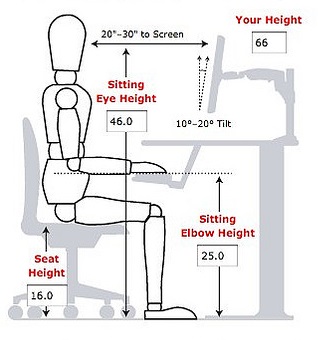
Ergonomics Definition
Ergonomics is the applied science of equipment design, as for the workplace, intended to maximize productivity by reducing operator fatigue and discomfort. The Word ergonomics is taken from the Greek words, “ergon” and “nomos”. Ergos means work and nomos means laws, when combined forms as laws of work.
In the present days Ergonomics definition is given as the science, which deals with designing the job to fit the worker, but not forcing them, to fit the job, from the physical stresses it focuses on joints, muscles, nerves, tendons, bones.
When we define ergonomics in term of science, it is the science of designing products that work in accordance with the way humans think, see, and behave. Products that are compatible with people will dramatically reduce human error, fatigue, discomfort, and stress, and have a profound positive impact on overall end-user performance.
The combined effect of good cognitive and physical ergonomics leads directly to consumer pleasure, fulfillment, and immediate acceptance of the product. Ergonomics reduces learning curves and limits the amount of customer education required for product sell-through.
In total, good ergonomics directly contributes to the success of the product and can be measured quantitatively in terms of customer satisfaction, market share, and profitability. Well-designed products sell. Poorly designed ones do not.
History Of Ergonomics
Ergonomics grew into a distinct scientific discipline during World War II. What began as a form of basic human engineering now encompasses a wide range of disciplines, including psychology, industrial design, medicine, and computer science.
Its practitioners' range of focus includes concept modeling and product design, job performance analysis, functional analysis, workspace and equipment design, computer interfaces, and environment design.
Characteristics Of Ergonomics
The basis of ergonomics understands the physical and cognitive/perceptual limitations of human performance relative to interaction with products. Such interface analysis is crucial to establishing a safe and effective system of operation for the user.
Cognitive Ergonomics
Proper fit of a product to a user does not end with physical interfaces. The perceptual and cognitive demands that a product places on the user must also be examined. Note that a great misconception regarding these areas of human functioning is that they relate to emotive - and therefore qualitative - responses of users.
But rather, both perceptual and cognitive behaviors offer fact-based, quantitative data that can be used in product development.
Physical Ergonomics
A thorough understanding of the physical characteristics of a wide range of people is essential in product development. When analyzing design relative to human performance, ergonomists study anthropometric data, which includes size percentiles of a wide range of populations defined along such lines as gender and age.
Ranges of joint motions, strengths, and grips for various populations are also reviewed. These data serve as valuable information to designers and help ensure that the final product will physically fit the targeted endusers. |